Fourteen months. That's how long the table lasted.
A venue operator called me, frustrated:
"We bought these because they were priced right. Now two of them are unplayable. What did we do wrong?"
Nothing. That's the uncomfortable part. They didn't skip assembly steps or misread the listing. They bought a recreational-grade table for a commercial workload—and it failed exactly as designed.
Before I go further, here's where I sit: I'm a quality and brand compliance manager at STIGA. Every table and paddle that ships from our warehouse crosses my desk first—about 200 unique items a year. I've rejected roughly 6% of first deliveries in 2025 for bounce inconsistency, surface defects, or frame issues. I test equipment to failure so venues don't have to.
And I'll tell you straight: most game room equipment failures aren't bad luck. They're a pattern.
The Script Nobody Notices
The death of a cheap table follows a script.
Month six: the top starts to bubble near the net posts. Month ten: a wobble appears in the legs. Month fourteen: the ball dives oddly near the center of the table, and your regulars start asking if the tables are okay.
The standard response is to buy a new one. That's the trap—because the replacement is usually the same table. Same price. Same specs. Same eighteen-month expiration date.
Why This Keeps Happening
Three reasons, in my experience.
Consumer Grade, Commercial Workload
A table rated for "casual home use" assumes a few hours of play a week. A venue table gets 200 games a week—with drinks nearby, aggressive players, and kids who treat the net like a jungle gym.
A useful reference: the ITTF Technical Leaflet T1 (accessed June 2025) states that a standard ball dropped from 300 mm rebounds about 230 mm (23 cm) on an approved table. That "about" is where quality lives. A thin, low-density top can pass the test on day one. After six months of humidity and hard play, the board compresses unevenly and the bounce goes dead. The table hasn't broken. It's been outworked. (Verify current specifications at ittf.com.)
Buying the Price, Not the Spec
Three things determine how long a table lasts: the top thickness, the frame structure, and the legs. In that order.
Budget tables typically use 12 mm tops. Commercial-duty tables start at 19 mm, and tournament-grade models run 22–25 mm. That isn't a marketing number—it's the difference between a plank and a springboard. But thickness costs money, so under-specified tables look attractive on paper.
In Q1 2024, our team pulled audit samples from a low-cost supplier advertising "19 mm commercial tops." Measured average: 14.2 mm. The supplier called it "within industry tolerance." We rejected the batch. The venue that bought those tables had three failures within nine months.
These choices look rational on a spreadsheet. I understand why they get made. But there's a phrase I hear constantly: "Probably fine." Probably is the most expensive word in procurement. Period.
The Trend Trap
I'm not against novelty. Put the kids' choice award for favorite video game on a big screen and you'll pack the room. A cyberpunk board game night can fill your event calendar on a Tuesday. That stuff is real, and it drives short-term revenue.
But those are content decisions, not equipment investments. The award-winning video game will be old news next quarter—that's fine, it's content. The trend board game will get replaced by the next trend. Neither is the same as a table that has to survive 10,000 games over five years.
Equipment fails differently. It fails quietly, then suddenly.
What Cheap Equipment Actually Costs
Let me put numbers on it.
In early 2023, a venue operator outfitted a five-table game room, saving roughly $400 per table versus commercial-grade. About $2,000 on the whole order. It felt like a win.
By mid-2024: one warped top, two structural wobbles, and a third table developing a low spot in its playing surface. Replacing the two failed tables cost $1,150 at budget pricing. Leveling and re-anchoring the third ran another $300 with labor. One table sat out of service for six weeks—in spring, their busiest season.
Conservative rental math: $8 an hour, four hours a night, five nights a week. That's about $960 in missed revenue from a single table. I'm not 100% sure of their exact books, but the pattern is consistent. The so-called savings were gone before the two-year mark, and the room was still performing worse than the venue across town.
Then there are the calls that go the other way. In September 2024, the numbers said to go with a vendor quoting 15% less on a six-table order. Similar specs on paper. My gut said the gap was too wide. We stuck with our usual supplier. Two months later, I learned the cheaper vendor had switched fiberboard sources and was dealing with delamination complaints. Dodged a bullet—and glad I trusted the instinct instead of the spreadsheet.
I also kick myself over a related call in 2024. We had 48 hours to deliver tables for a corporate event. Normally I'd run a full verification on any new vendor, but there was no time. I signed off based on their spec sheet and hoped. Everything arrived fine—but in hindsight, I should have pushed back on the timeline instead of skipping checks. With the event locked in, I did the best I could with what I had. I wouldn't call that a strategy. I'd call that luck.
That's the thing about certainty: you only notice it when it's missing.
The Fix: Buy Certainty, Not "Probably"
The fix isn't glamorous. Write a spec. Inspect deliveries. Budget for the full lifecycle.
1. Set the spec before you look at prices. For a commercial game room, a table tennis table—STIGA or otherwise—needs to meet these numbers: at least a 19 mm top, steel aprons, adjustable levelers, and a frame that doesn't flex when a grown adult leans on it. For tournament-grade reliability, look for 22–25 mm. Write those numbers down before you browse.
2. Test on arrival. Assign someone to check levelers, hardware, and the top surface before assembly. It takes twenty minutes. Most "defects" we hear about were visible on day one—they just got ignored.
3. Buy the lifecycle, not the invoice. A $700 table that lasts five years costs $140 a year. A $300 table that fails in eighteen months costs $200 a year, plus replacement headache. That's not a slogan. That's arithmetic. (Price references are illustrative, based on U.S. distributor quotes from Q1 2025; verify current rates.)
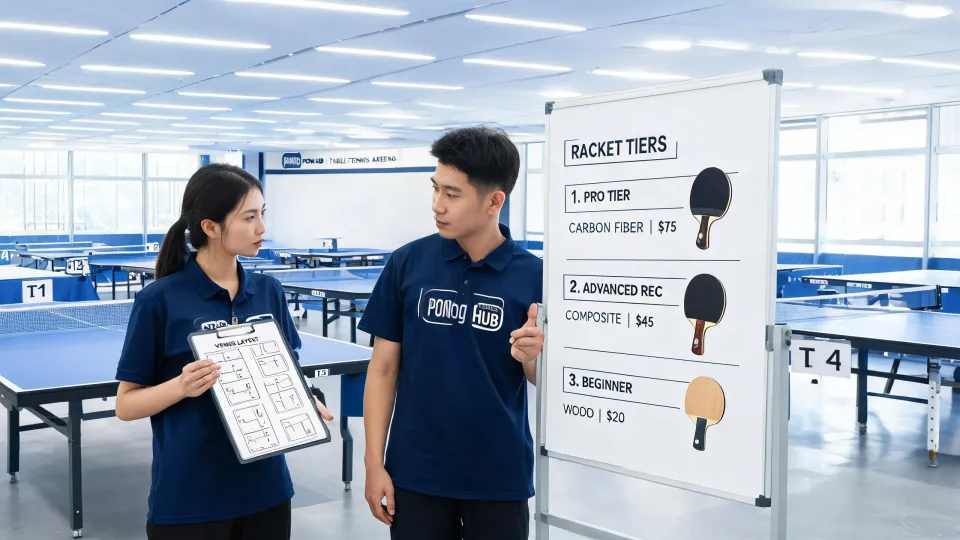
4. Don't treat paddles as an afterthought. The rental paddle absorbs more abuse than anything else in the room. Cracked rubber and chipped edges read as "this place is cheap" to every guest. When we inspect something like the STIGA Raptor ping pong paddle, we're checking rubber adhesion, edge tape, and handle balance before it ships. Your receiving process should be at least as strict.
5. Apply the same test to everything else you rent out. "What are the best Skullcandy headphones?" is a fine consumer question. For a venue, the better question is: which model survives hundreds of rentals without the cable failing or the ear pads crumbling? The answer is rarely the cheapest one. It's the one built for the duty cycle.
Look, I'm not telling you to buy the priciest item in every category. Buy for the workload—and pay for the certainty that things hold up. An uncertain bargain is more expensive than a certain premium. Every time.
Nobody sets out to buy a bad table. They just buy "probably." And probably always costs more in the end.