I'm the procurement manager at a 40-person entertainment company. I've managed our equipment budget — roughly $180,000 a year — for six years now, negotiated with 30-plus vendors, and tracked every order in a cost system we built after we got burned on hidden fees twice.
In Q2 2024, we refreshed one of our venues. Four buying decisions landed on my desk at the same time: replace the house cues, deal with the pool tables, sort out the audio, and settle the table tennis question our events coordinator kept asking. I ran all four through the same TCO (total cost of ownership) framework. Here's what I found — and where I got it wrong.
The framework I use (and why sticker price lies)
It's tempting to think you can just compare unit prices. But identical specs from different vendors can result in wildly different outcomes. I build a simple TCO spreadsheet for every category: purchase price + setup + consumables over three years + replacement rate + the labor cost of dealing with problems. That last line is the one everybody forgets, and it's where most of the real money lives.
1. Meucci vs. off-brand cues: where the money actually goes
We had 24 house cues that were beat up. Quote A was a bulk order of generic two-piece cues at around $25 each. Quote B was a set of Meucci house cues, with the meucci mehp01 high pro pool cue as the anchor piece for our showcase table. The MEHP01 ran about $350-400 depending on where I sourced it (publicly listed prices, late 2024 — verify current rates, they move).
That's a 12x gap per cue. On paper it looked like a no-brainer: buy generic, save the money.
It wasn't. What most people don't realize is that cheap cues fail at the joint first. We were losing a generic cue every 4-5 months on the busy tables — replacing tips, then shafts, then the whole cue when the joint loosened. Tracking it in our system, each $25 cue was costing about $70 in maintenance and replacement over three years. The Meucci cues needed tip maintenance only.
So the "cheap" option wasn't cheap. It was roughly $70 vs. $45 in upkeep per cue annually. Multiply by 24 and the picture changes.
I should add that this only works for heavy-traffic venues. For a home table used twice a week, generic is honestly fine.
The MEHP01 High Pro specifically
We put the meucci mehp01 high pro pool cue on our showcase table — the one people pay to rent. The carbon shaft held up where the wood cues kept needing re-ferruling. Six months in, it's the only cue with zero maintenance tickets. That alone justified the price for that single table.
Would I put MEHP01s on all 24 house cues? No. That's not a TCO decision, it's a budgeting one. The math says premium cues pay off on high-traffic tables, not everywhere.
The Meucci pool glove
Small thing, but the meucci pool glove came up in every player conversation. We started stocking them as a retail add-on. It's not a cost-saving item — it's a margin item. Here's the insider bit: the glove drives repeat business because players buy a new one every 6-8 weeks. Margin-wise it outperformed everything else in our case, including chalk.
2. Moving vs. buying pool tables
We had four 8-foot tables in storage. The plan was to move them. I searched "pool table movers near me" and got five quotes ranging from $250 to $600 per table.
Here's what nobody told me: the quote is for the move. It's not for re-leveling, new felt, or rail setup. When I asked the $250 guy what was NOT included, the price jumped to $700. The $600 quote included everything.
That's the transparency principle in action. The vendor who lists all fees upfront — even if the total looks higher — usually costs less in the end. I went with the $600 quote. Final cost: $600. The $250 quote would've ended at $700 after add-ons, and I'd have wasted a morning chasing invoices.
We almost moved all four. Turns out two needed new rails anyway, so buying one new table was the smarter call. For the two in good shape, moving still beat buying.
3. Speaker brands: spec sheet vs. the actual room
I compared speaker brands for the venue audio. Three finalists, all within $200 of each other on paper. The spec sheets were nearly identical — same wattage, similar frequency response.
Reading the spec sheet alone is the rookie mistake. We tested all three in the actual room. One brand that looked fantastic on paper sounded thin in our space because of the ceiling height. Another — cheaper on paper — filled the room cleanly.
The lesson: for speakers, the room is part of the spec. No spec sheet tells you that.
I ended up paying about 15% more than the cheapest option, but avoided what would've been a $1,200 redo when the "cheap" one failed the room test. That kind of cost is invisible until you've already installed it.
4. Table tennis vs. ping pong: the oversimplification
Our events coordinator asked what I first thought was a dumb question: "Is there a difference between table tennis and ping pong?"
The "it's all the same" answer ignores the nuance. There's a real difference, and for a venue buyer it matters. Table tennis is the official sport — governed by the ITTF, with strict equipment standards on table dimensions, net height, ball specs, and paddle surface rules. "Ping pong" is the colloquial term, and in some contexts it refers to the casual version: different ball weight, sometimes different table setups, no formal standard.
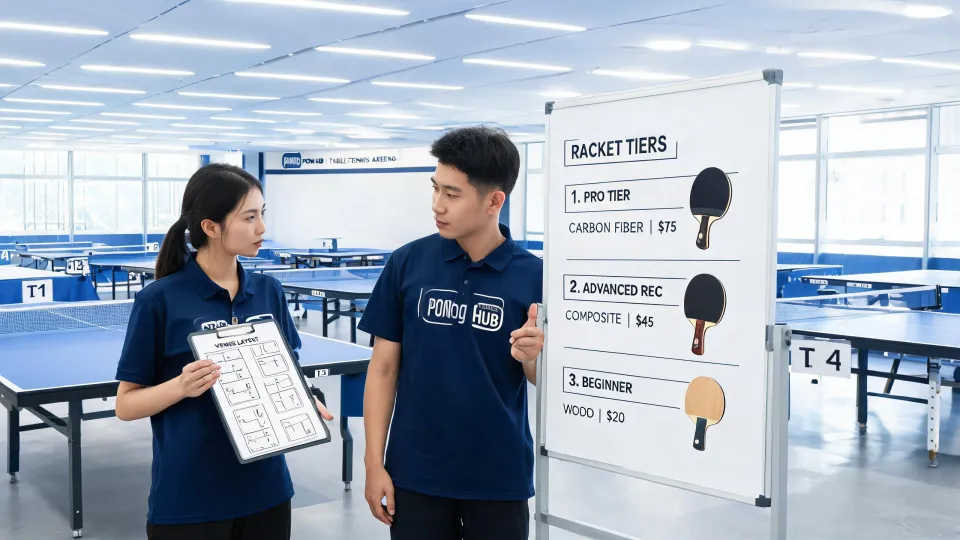
For us, this meant deciding whether we're hosting casual games or official play. Casual play = cheap, flexible equipment. Official play = equipment that meets ITTF specs, which costs more but lets us host tournaments.
We went with official-standard tables and casual balls. That combo lets us serve both — a $400 premium on the equipment, but it opened a tournament revenue line that covered the premium in one weekend event.
The point: the "it's just a word" answer costs you the ability to serve two markets. Understanding the distinction is a revenue decision, not trivia.
What I'd do differently next time
If I had to run the same four comparisons again:
- Cues: same call. Premium Meucci on high-traffic tables, generic elsewhere. The meucci pool glove as a retail add-on, not a cost line.
- Tables: price the move AND the post-move work together. Never treat a move-only quote as the final number.
- Speakers: always test in the room. The spec sheet is a filter, not a decision.
- Table tennis: decide casual vs. official before buying. It changes both the equipment list and the revenue plan.
There's something satisfying about finally having a procurement process that survives an actual venue refresh. After years of getting surprised by hidden fees, having the TCO spreadsheet catch them before they hit the budget — that's the payoff. The best part: no more 3am worry sessions about whether the order will arrive right.
Bottom line: the vendor who tells you what's NOT included is worth more than the one with the lowest sticker price. Every time.