-
Three Questions That Decide Your Choice
-
Scenario 1: The Casual or Social Player (the "Table Tennis Near Me" Crowd)
-
Scenario 2: The Club Player or Structured Trainer (STIGA Carbon+ Table Tennis Racket)
-
Scenario 3: The Facility Owner, Club Manager, or Retail Buyer (B2B)
-
How to Tell Which Scenario You're In
-
Scope Note: Other Entertainment Center Searches
-
Bottom Line
Let me say one thing upfront: there's no single "best" STIGA ping pong bat. There's the bat that fits your situation. As a quality and brand compliance manager, I review over 200 unique STIGA items every year—blades, rubbers, assembled paddles, and tables. I check specifications against what's promised. If there's one lesson that sticks, it's this: know your scenario before you buy a STIGA table tennis racket.
Three Questions That Decide Your Choice
STIGA makes everything from simple bats for casual play to competition-level carbon blades. Which one should you actually use? Ask yourself:
- How often do you play? Once a month is different from five times a week.
- Where do you play? At home, a community center, a club, or the place you found via a "table tennis near me" search.
- What's your budget horizon? Are you buying for one season or for years of structured training?
Here's the thing: a $150 professional blade can be a waste of money if you play once a month. But it can be the best $150 you'll spend if you train every week. So let's break it down by scenario.
Scenario 1: The Casual or Social Player (the "Table Tennis Near Me" Crowd)
You play friendly matches at a local recreation center, a school, or an office. You care about having fun and making good shots, but you don't do multi-ball training. You don't need the fastest blade on the market—you need something balanced, durable, and low-maintenance.
For this scenario, the STIGA Inspire is a reliable choice. In my spring 2025 spec checks, it had consistent bounce and a comfortable grip. It's not a weapon. It's not meant to be. The price tends to land around $35–60 based on major online retailer quotes from June 2025—verify current rates before ordering.
The STIGA Evolution is similar but slightly heavier. If you like a bit more weight in your hand, it works. If you have a sensitive wrist, skip it. There are also cheaper STIGA bats around $20, and they're fine—at least, fine for occasional play. They won't help you generate heavy spin, but that's not what they're designed for.
Common mistake: players buy the fastest blade expecting it to improve their game. For a casual player, a slower bat usually gives more control and consistency. A fast bat doesn't fix technique. It amplifies it.
Scenario 2: The Club Player or Structured Trainer (STIGA Carbon+ Table Tennis Racket)
If you train at a club and you've outgrown your recreational paddle, the STIGA Carbon+ is likely on your radar. It's the racket that gets the most questions in my inbox, and I understand why.
The "Carbon+" refers to carbon layers inside the blade (i.e., carbon-reinforced plies). Carbon adds stiffness and speed. It does not magically create spin for you. In fact, if your footwork and contact point aren't consistent, a carbon blade can feel twitchy and hard to control.
For most players, buying the complete STIGA Carbon+ table tennis racket is the best move—you get a well-matched rubber combination out of the box. Later, when you develop a clearer playing style, you can buy the Carbon+ blade separately and pair it with a specific rubber like the STIGA Mantra series.
In Q1 2025, I ran a quality audit on a batch of Carbon+ rackets. Weights were consistent, and the handle finish was clean. The main variable was the attached rubber: one batch had slight edge separation after heavy use. So test the racket with a real ball before you commit. Don't just trust the packaging.
(Pricing for the Carbon+ blade was around $100–140 in official STIGA product listings as of June 2025; a complete racket costs more. Verify current prices before you buy.)
Scenario 3: The Facility Owner, Club Manager, or Retail Buyer (B2B)
Now let's talk about the people buying for a whole room, not just themselves. This is where my own purchasing history gets personal.
For public-use spaces, the STIGA Competition Line tables are a solid investment. I've seen these withstand years of community-center use. The nets clip securely, the locking mechanisms hold up, and the playing surface stays true—which is more than I can say for some cheaper no-name tables.
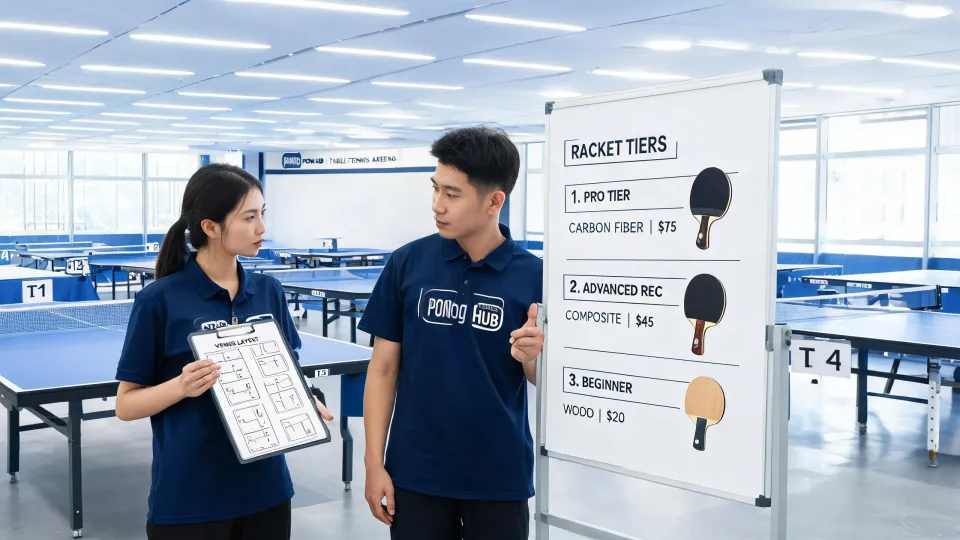
For paddle inventory, a mixed strategy works best:
- Several recreational STIGA bats for casual visitors.
- A few Carbon+ rackets available for serious club members.
- At least two replacement rubbers, because public-use paddles get damaged.
Don't stock forty high-end rackets and hope people will use them. I once saw a community center with a box of expensive carbon blades untouched because casual players were afraid of breaking them. That's not a quality failure. That's a buying failure.
One thing I feel strongly about: small orders should not be treated like a nuisance. When I started as a buyer, I placed a trial order for just 10 STIGA paddles. Some suppliers brushed me off. The one who took my $200 order seriously is still the supplier I use today for $20,000 orders. Small doesn't mean unimportant—it means potential. That said, small order size doesn't mean prices should equal bulk prices. Fair pricing is about actual shipping and handling costs, not about disrespect.
How to Tell Which Scenario You're In
If you're still unsure, here's a quick self-test:
- How many times did you play in the last 30 days? Less than 4? Scenario 1.
- Do you do planned drills, or do you only play matches? Drills + matches? Scenario 2. Only matches? Probably Scenario 1.
- Are you buying for one person or for a facility? One person? Scenario 1 or 2. Multiple tables or bulk equipment? Scenario 3.
And about that "table tennis near me" search: it's great for finding a place to try equipment before buying. Just remember that a good club and a good purchase aren't the same decision. If the whole club plays with Carbon+, that doesn't mean you need one—especially if you're only playing twice a month.
Scope Note: Other Entertainment Center Searches
I've focused this guide on STIGA and table tennis. If you're planning a full entertainment space, you may have also searched for a "JBL speaker party box" for a party room, or "what is a video game designer" if you're considering an arcade corner. Those topics are outside this guide, but they're legitimate parts of facility planning. The table tennis area can be the anchor of an entertainment venue—but it doesn't have to be the only element.
Bottom Line
Don't buy for a marketing logo. Don't buy because a pro player uses it. Buy for your frequency, your venue, and your realistic long-term plan. STIGA has been building quality blades since 1944, so you're in good hands regardless. The real question is whether you're in the right scenario.
Now go find your table, give it a good hit, and choose the bat that fits your game.