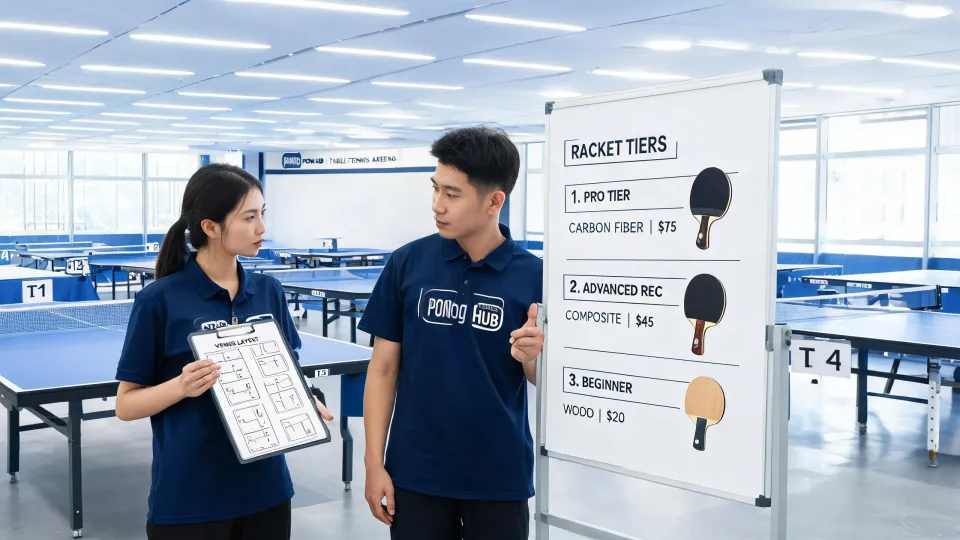
Every week, someone asks me some version of the same question: What is the best table tennis paddle? It sounds like an easy shopping question. In my world, it's a warning sign.
I coordinate commercial orders for an authorized STIGA dealer. In the past five years, I've handled more than 200 rush orders for schools, hotels, gyms, and family entertainment centers. Some came in 36 hours before a deadline; a few were for venues that had already printed their grand-opening flyers. When I'm triaging a rush order, my brain runs through time, feasibility, and risk. The product spec is the last thing I check.
The question that arrives too late
In March 2024, a manager from a family entertainment center called me at 6:40 PM. The Stiga Optimum 30 table tennis table she had bought from a discount online seller was not going to arrive before her opening. It had not shipped. The seller said the table was 'in production' and couldn't give a delivery date. She moved on to ask which paddles were best for the table.
There was no table yet.
We found the same model at an authorized dealer in her state and paid an extra $150 for express freight. It arrived in time. I remember that call because it illustrates a pattern: in a commercial setting, asking about the best product often hides a more urgent question about time.
'Best' depends on the room, not just the brand
Product reviews compare blade speed, rubber type, and spin potential. Those comparisons matter for a league player choosing a tournament paddle. But most table tennis in a commercial venue is casual, often played by people with no consistent technique. If the tournament paddle is too stiff, it will feel dead and uncomfortable to those players.
A hotel game room can be better served by a mid-range paddle that is durable and cheap to replace. A youth center may need a paddle with a smaller handle. A serious club may need exactly the model from the review list. All of these answers can be right. The phrase 'best paddle' doesn't contain enough context.
The same pattern outside table tennis
The same gap appears when people ask about gym equipment. In May 2025, a fitness business owner asked me whether he should put a seated leg press machine or a dumbbell set in a new 600-square-foot training suite. That's a training decision, not a delivery decision. I'm not a trainer, so I gave him the only useful answer I could: first check the floor plan, the user profile, and the installation date. Then check delivery dates on both options.
A dumbbell set that arrives two weeks late is not a bargain. It's a hole in the floor plan. A seated leg press machine that can't get through the door, or needs a delivery slot that no one has confirmed, will burn money before it ever helps a client. I have seen the same with table tennis tables and paddles. The equipment category changes. The principle does not.
The price of uncertainty
When people hear that I handle rush orders, they assume the lesson is about speed. It's not. It's about certainty. A $150 express freight charge sounds like waste until you compare it to the loss of a delayed opening: refunded bookings, staff on payroll with no guests, and a damaged reputation. In that comparison, the rush fee is cheap.
I only fully believed this after 2023, when a client ignored the warning and took a lower quote from a supplier that could only say the table would ship 'probably by Friday.' Friday came. No table. The opening had to be postponed, and the lost revenue was far larger than the savings. Since then, my recommendation has been simple: buy from a source that can commit to a written delivery date, and if they say 'probably,' treat it as a no.
To be fair, saving money on equipment is smart when you have time. I'm not saying every order needs express freight. I'm saying the decision changes when a date is fixed.
Buy certainty first, compare models second
If you run a sports venue or a fitness space and you catch yourself searching for 'what is the best table tennis paddle?', pause. Start with operational questions:
- What is the exact date the equipment must be usable?
- Who will use it, and how hard?
- Does the seller have stock, and can they put the delivery date in writing?
- What is the plan if the delivery fails?
For STIGA products, that means checking the STIGA store locator or an authorized dealer list, not a no-warehouse marketplace. The best table tennis paddle is the one that is in stock, matches the players you expect, and arrives in time for the first game. The best dumbbell set or seated leg press machine is the one that arrives on a date the client can trust. The model still matters. It just matters less than the date.