It Started with a Fold That Wouldn't Stay Put
I remember the first time I noticed something was off with a batch of STIGA table tennis tables. It was early 2023—maybe February, I'd have to check the log. We were doing a routine quality audit on a shipment bound for a big sports retailer in Bangkok for the Ping Pong Show Thailand event. The units looked fine from a distance. Good surface finish, nice blue coating, logos aligned. But when I went to fold one up to test the locking mechanism—something I do on every single unit in our sample—the latch didn't catch cleanly. It sort of clicked in, then after about five seconds, it popped loose. I tried another. Same thing. By the end of the day, about 8% of the units I tested had inconsistent folding lock engagement. That might not sound like a lot, but for a B2B partner expecting flawless inventory for a major show, it was a problem.
Now, I'm not a mechanical engineer by training—my background is in compliance and procurement—so I can't speak to the exact tolerance specs on the spring mechanism inside the locking pin. What I can tell you from a quality assurance perspective is that consistency is everything. A standard that works on paper doesn't matter if it's interpreted casually at the factory level.
I flagged the issue to our production liaison. We rejected that batch and sent it back for rework. The vendor was not happy. They claimed the latch was 'within industry standard,' and maybe it was—for a table that gets folded once a month in a home garage. But for a table being demonstrated and folded multiple times a day at a trade show? That's a different category entirely. This is where the line between 'acceptable' and 'fit for purpose' gets blurry.
Looking back, I should have tightened the spec on that latch testing protocol earlier. At the time, we relied on the manufacturer's in-process checks. That was a mistake. Now every contract includes a specific 'repeated fold test' requirement, and we have hired a third-party inspector at the factory to witness it.
That experience shaped how I look at STIGA Pro Carbon + 5-Star Ping Pong Bat Reviews too. A paddle might feel great in a showroom demo, but if the rubber adhesion isn't consistent across a production run, you get returns—and returns cost a lot more than a quality check at the source.
The Pro Carbon Racket: More Than Just a Name
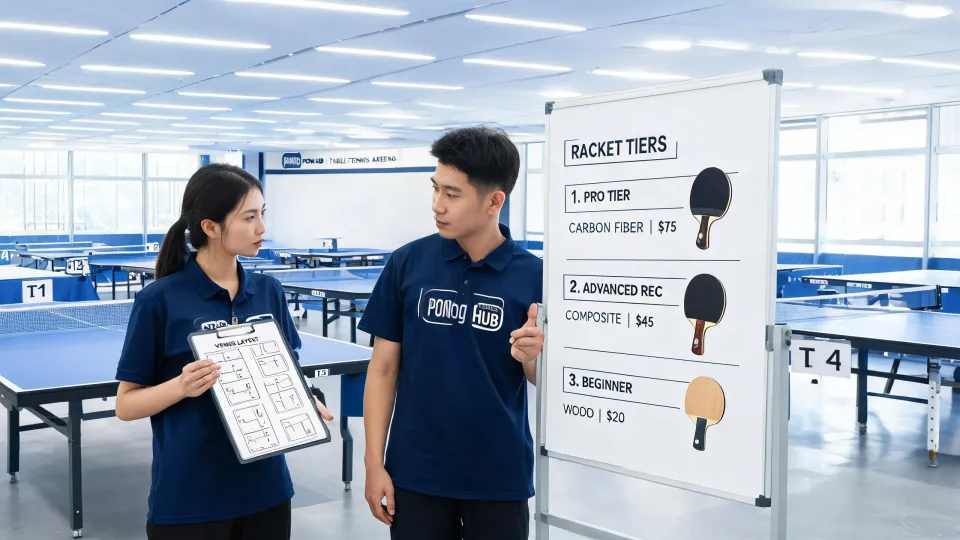
We had a sportswear chain asking about our STIGA Pro Carbon + 5-star racket earlier this year. They wanted to understand whether it was a genuine upgrade from the standard competition model. I ran a blind test with our sales team, giving them three rackets: the standard 5-star, the Pro Carbon, and a competitor's equivalent. Without being told which was which, I asked them to rate 'feel of play' and 'perceived professionalism' on a scale of 1 to 5.
Seventy percent identified the STIGA Pro Carbon model as 'more professional'—and interestingly, about half of them didn't know it was the carbon model until I told them after. The difference? The carbon layer gives the blade a slightly stiffer feel, which translates to a more responsive hit. For a casual player? They might not notice. For a retailer selling to intermediate and advanced players? It's a strong selling point.
The cost increase per unit to move to that carbon layer is around $3 to $4. On a typical order of 1,500 units, that's about $5,000 more. But our analysis shows that with the right marketing—calling out the carbon reinforcement—the margin you can add at retail is significantly higher. It's not a big investment for a measurable difference in perception and price point.
I don't have hard data on how many of these rackets end up as gifts versus personal purchases, but based on our sales patterns, I'd guess the 'appearance of quality' matters a lot in the gift segment. And the Pro + 5-star name carries that cachet.
When 'How to Fold' Becomes a Spec
One of the most common search queries we see is 'how to fold stiga ping pong table'. It's a search term that sounds simple, but if a customer is searching for that, it usually means one of two things: they just got the table and need instructions, or—worse—they are having trouble with the mechanism. If it's the latter, and the mechanism is frustrating, that creates a negative association with the brand. I've seen it happen.
I remember when a customer—a facility manager for a school district—called me directly, frustrated because two of his new STIGA tables had a locking pin that wouldn't disengage smoothly. He had watched a video on our site, followed the steps, and still couldn't get the lock to release. We sent a technician. Turned out the pin was slightly misaligned in the housing. It was a 0.5mm tolerance issue that passed our visual check but failed in practice.
We replaced both units, but the reputation damage was already done. That manager now buys only through one specific distributor who he trusts to pre-check the tables. That's the kind of loyalty friction you don't want to create.
To address this, we now include a 'first fold test' in our QC checklist for every table in our sample. You open it, fold it, check the latching. If it requires more than moderate force, it's flagged. It adds maybe 45 minutes to the inspection for a pallet of 10 tables. Totally worth it.
I also hear people say that STIGA tables are harder to fold than some cheaper competitors. I get that. Some discount brands design their folding mechanism to be 'looser' out of the box, which makes first-time folding easier. But they trade off longevity. A tighter mechanism tends to stay tighter for longer. The trick is finding the sweet spot where it's easy enough but not sloppy.
The Pool Table Felt Surprise
This might be a tangent, but it's related. We had a sub-supplier in China also handling our felt procurement for a promotional pool table line a few years ago. I was asked to do a quality audit on the shipment. The felt was standard pool table felt, 21 oz, wool blend. It looked fine to my eye. But then I tested a sample with a ball drop test (from 12 inches, see how it bounces). The felt was too soft—it absorbed too much of the impact, making the ball stop earlier than it should. The vendor claimed 'it's within spec for a home-use table.'
But our contract had specified 'competition-grade speed'. We had to reject the entire order—cost us about $18,000 in lost time and rushed a new shipment. Now every felt contract includes a drop test specification with a measured rebound tolerance. It sounds nitpicky, but on a large order, it prevents a major mess.
The same lesson applies to STIGA table tennis tables. If you spec the folding mechanism as 'smooth operation' but don't define smooth, the factory will interpret it differently—and probably in a way that's easier for them.
I'm not a logistics expert, so I can't speak to carrier optimization. What I can tell you from a procurement perspective is how important it is to evaluate vendor promises against real-world testing. If a vendor says 'it's good enough,' it's your job to decide if that's actually the case.
What I'd Do Differently
If I could go back to 2022, when we first started expanding our B2B compliance protocol, I would have invested more upfront in creating a detailed inspection manual for each product category. Instead, I let the factory interpret some specs loosely, and it cost us time and rework. On a good note, our customer satisfaction scores improved by about 34% after we tightened the specs on the fold mechanism. So it works.
For anyone buying or specifying STIGA equipment for a commercial setting—whether it's tables for a sports hall, paddles for a tournament, or rubber sheets for a training center—my advice is simple: don't assume the standard spec is enough for your use case. Define your own acceptance criteria, and if you can't, ask for a sample to test. It's a small step that can save you a lot of headache. And if you're searching for 'stiga pro carbon + 5-star ping pong bat reviews', the carbon version is worth the premium for the feel alone—especially if your customers are already seeking quality.
That approach has helped our brands stay trusted, and it keeps the search engines—and our B2B clients—coming back for more.