-
What I Check Before a Game Room Order Reaches the Floor
-
Should the STIGA Baja Outdoor Table Tennis Table Be Your First Outdoor Choice?
-
Is the STIGA Carbon+ Ping Pong Paddle Worth Adding to Your Order?
-
What Is a Slate Pool Table?
-
How Do You Choose a Commercial-Grade Weight Bench Set?
-
Is a Classic Space Invaders Arcade Game a Safe Investment?
-
Is a Fixed Delivery Date Worth Paying Extra For?
What I Check Before a Game Room Order Reaches the Floor
If you're outfitting a commercial game room, the product list usually feels like a shopping cart: a table tennis table or two, a pool table, one nostalgia arcade cabinet, and a strength bench so adults have something to do while kids play. The part buyers don't see is the inspection process behind that list.
I'm a quality and compliance manager for an indoor-recreation supplier. I review roughly 200 unique products a year—table tennis tables, arcade cabinets, fitness benches, pool tables—before we recommend them or put them on a showroom floor. During our Q1 2024 review, I rejected 12% of first samples for issues like unstable leg locks and hardware that didn't match the spec sheet. That's not pickiness; consistency is the whole job.
This guide answers the STIGA-related questions I get most, plus the other equipment buyers ask about in the same conversation.
Quick question map:
- Should the STIGA Baja outdoor table tennis table be your first outdoor choice?
- Does the STIGA Carbon+ ping pong paddle make sense for shared use?
- What is a slate pool table?
- How do you choose a commercial-grade weight bench set?
- Is a classic Space Invaders arcade game a safe investment?
- Is a fixed delivery date worth paying extra for?
Should the STIGA Baja Outdoor Table Tennis Table Be Your First Outdoor Choice?
If the table will sit on an uncovered patio, rooftop, or courtyard, I usually say yes. The STIGA Baja outdoor table tennis table is made for weather that would cause problems for an indoor model over time. A weather-resistant top and rust-resistant frame are the real reasons to choose an outdoor-specific unit, not brand hype. You still need a cover, and you still need to bring paddles and balls inside at night. Outdoor-rated doesn't mean maintenance-free.
My first-year mistake on outdoor tables: I checked the playing surface and the fold-lock mechanism, but not the delivery path. When the first big order arrived, each table was heavier and bulkier than the photos suggested. The site manager said the entrance was fine; it was not fine. Confirm door widths, elevators, and liftgate service before you commit to a model.
Do the wobble test too. Lock the legs, push on opposite corners, and watch for movement. A table that rolls smoothly but rocks during play will collect complaints before lunch.
Is the STIGA Carbon+ Ping Pong Paddle Worth Adding to Your Order?
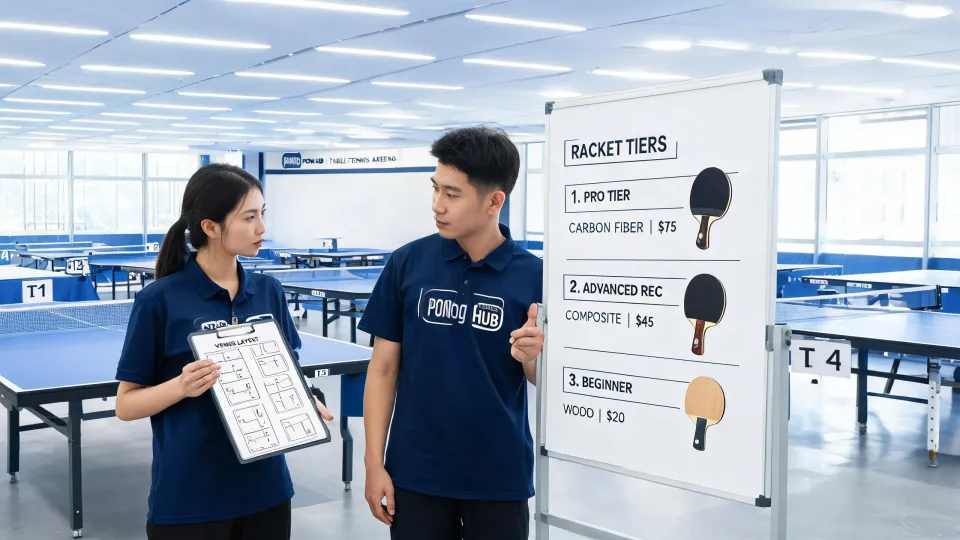
For a facility that needs one consistent paddle instead of a basket of mismatched rackets, yes. The STIGA Carbon+ ping pong paddle uses a carbon-reinforced blade, which stiffens the face and adds a little speed compared with a basic wood paddle. I won't pretend it turns a casual player into a pro; it doesn't. What you're paying for is predictable performance and better edge protection.
My quick bench test is to hold the handle, press the rubber near the edge, and check whether the sponge lifts away from the blade. Cheap paddles often feel okay for the first session; after a month of walk-up use, the rubber starts peeling around the edges and players feel it at contact. The Carbon+ holds up better in that test, which matters when you order 50 identical paddles and expect every one to feel the same.
For shared equipment, I'd rather see a facility stock a mid-level paddle like this than buy the cheapest option in bulk. The model name matters less than rubber adhesion, blade consistency, and whether customers can grab a paddle without inspecting it first.
What Is a Slate Pool Table?
A slate pool table is one with a playing bed made of natural slate, usually in three slabs. An installer bolts the slabs together, fills the seams, then scrapes them level with the rest of the bed. Slate is dense and stable, so the table can be leveled properly when it's set up. That combination of flatness and weight is why commercial players prefer it.
The phrase means different things to a player and to a buyer. To a player, slate explains why the ball rolls true. To a buyer, slate means the table is heavy, needs professional setup, and has to be leveled again whenever it is moved. A non-slate bed made of wood or engineered board can cost less, but it can also warp in humid conditions. Once it warps, no amount of frame adjustment can bring it back.
When you compare prices, ask what is under the cloth before you ask about brand or style. If two pool tables look similar and the price gap is wide, the playing surface is usually the reason.
How Do You Choose a Commercial-Grade Weight Bench Set?
A weight bench set looks almost identical in most product photos. The differences are internal: steel tube thickness, weld quality, hardware grade, foam density, and how tightly the barbell sleeves fit.
I start by loading weight on one side only. If the frame twists, it fails. Then I sit on the bench and rock side to side; a pad that squishes unevenly may work at home but not in a public space. I also want to know if the locking pins and adjustment parts are replaceable, because those are the first components to wear out.
One thing buyers forget is that the printed maximum weight rating isn't a durability rating. It tells you the frame shouldn't snap under a centered static load, but people don't always load a bar evenly. A commercial weight bench set should stay stable under rough use, not just under a perfectly balanced lift.
The same total-cost logic applies here. A cheaper bench with no replacement parts becomes expensive the first time a pin bends or a pad splits.
Is a Classic Space Invaders Arcade Game a Safe Investment?
It can be one of the more reliable draws in a game room, if you treat it as a commercial appliance rather than a nostalgia piece. A Space Invaders arcade game is decades-old hardware. The monitor, controls, power supply, and coin mechanism all need attention, especially with daily use.
Before you buy, ask who supports it after delivery. Does the seller have service documentation, spare controls, and a source for replacement boards? I've watched operators buy a cabinet that looked amazing in photos, then wait weeks for a repair because nobody had a schematic. A classic cabinet is only profitable while it's playable.
If you're comparing a restored original with an LCD conversion, decide who will fix it if something goes wrong. Original CRT monitors produce the authentic look but require more specialized service. LCD conversions are easier to maintain but can feel different to players who remember the original. Both can work; the bad scenario is buying a pretty machine with no support plan.
Is a Fixed Delivery Date Worth Paying Extra For?
If the calendar is fixed, yes. You're not paying for speed; you're paying for certainty. A table that arrives Friday instead of Monday matters when you open Saturday. It means a call to the electrician, a crew standing around, and a room that doesn't look ready.
In 2022, I started adding confirmed delivery windows to my review process. Shipping quotes went up, but the number of last-minute fire drills went down. That's a trade-off I'll make every time. A less expensive option with an estimated date is a gamble; the lowest quote isn't the lowest total cost if a missed arrival creates a second installation visit.
Ask what the delivery price actually covers. Does it include a liftgate, a threshold drop, and a clear time window? The same logic applies to table tennis tables, pool tables, arcade cabinets, and fitness benches. There's something satisfying about an order that arrives on the confirmed date and passes inspection without missing hardware or damage. That should be normal, but it's still rare enough to appreciate.