Not Everything Fits Every Space
Here's the thing: there's no single 'best' STIGA product for every business buyer. What works for a high-traffic rec center won't suit a corporate break room. The STIGA XTR Pro is a beast of an outdoor table—but it's probably overkill for a school's indoor gym. And the Carbon+ paddle? Depends entirely on who's using it.
I manage purchasing for a mid-sized entertainment company—about $150k annually across 30+ vendors. For the last three years, I've been ordering table tennis equipment for 6 venues. I've made mistakes. Good ones and bad ones. Here's what I've found works, broken down by situation.
Three distinct buyer scenarios, three different approaches:
- High-traffic, all-weather venues (outdoor courts, parks, multi-sport centers)
- Performance-focused facilities (training centers, competitive clubs, clubs with leagues)
- Budget-conscious, multi-purpose spaces (schools, rec centers, offices)
Scenario A: High-Traffic, All-Weather (The Outdoor Court)
If you're equipping an outdoor table tennis area that sees daily use, rain or shine, the STIGA XTR Pro Outdoor Table is your workhorse. It's not the cheapest—around $800–1,200 depending on the dealer—but it's built for abuse.
I put one in a park near a beach. Salt air, wind, the occasional bird... it's held up for 18 months with minimal maintenance. The aluminum composite top doesn't warp like some cheaper MDF tables do after a few wet seasons. The 3-inch frame is solid; I've seen adults lean on it without it buckling.
What I'd check before ordering:
- Is the surface level? The XTR Pro has adjustable leg levelers—critical for uneven ground.
- Playback mode? Yes, it folds for solo practice. Useful for drills.
- Net system? It's the standard STIGA net. Fine, but consider upgrading the net if you're hosting tournaments.
Honestly, I'm not sure why some outdoor tables from other brands have non-adjustable nets. The XTR Pro's is basic but functional. If you're buying for a park, factor in adding a higher-quality net if competitive play is expected.
Price note: Based on dealer quotes I received in early 2025, the XTR Pro ranges from $850 to $1,150. Shipping adds $100–$200 depending on location. Setup is straightforward—takes two people about an hour.
Scenario B: Performance-Focused (The Training Center or Club)
If your venue runs leagues or has dedicated players, the paddle matters more than the table. The STIGA Carbon+ Ping Pong Paddle is a solid mid-range option for serious recreational players—but it's not for everyone.
I went back and forth between the Carbon+ and the Pro Carbon for about two weeks. The Carbon+ offers good spin (ITTF-approved rubber) and a carbon blade for speed. The Pro Carbon is faster but less forgiving for intermediate players. For a club that sees mixed skill levels, the Carbon+ is the safer choice—it gives advanced players enough control while still being approachable for intermediate players.
I ordered 24 Carbon+ paddles for a training center in late 2024. Feedback was positive: 'good grip,' 'consistent feel,' 'not too heavy.' But one coach noted that the rubber wears faster than premium options after about 6 months of daily use. That's a trade-off for the price point.
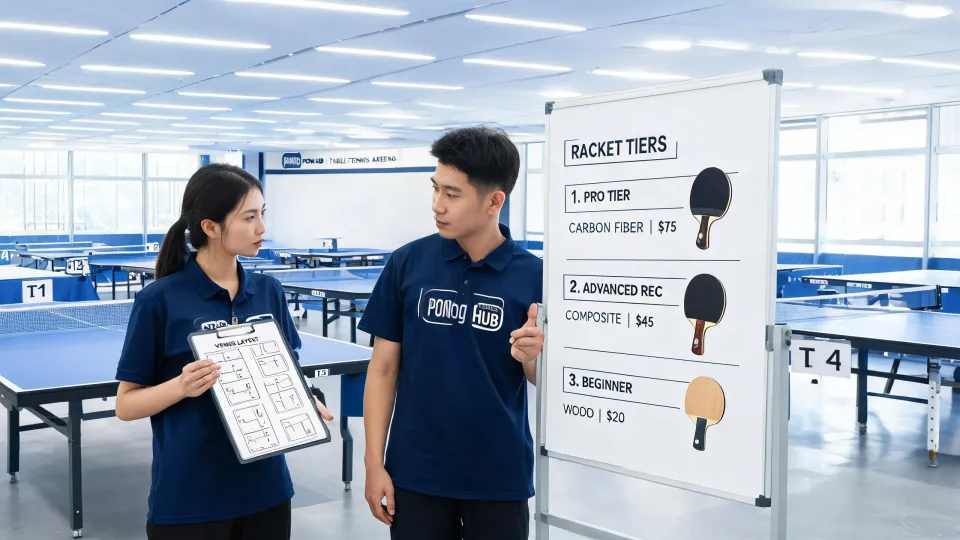
Bulk purchase tip: STIGA offers tiered pricing for 12+ units. I got a 15% discount for a 24-paddle order, with free standard shipping. That came out to roughly $28 per paddle, compared to the $35 retail price.
Avoid if: Your players are beginners. The Carbon+ might be too much blade for absolute novices—they'll struggle with control. For school programs or casual drop-in, stick with the STIGA S5000 or similar cheaper composite paddles.
Scenario C: Budget-Conscious, Multi-Purpose (Schools, Rec Centers, Offices)
For a school project on a budget, you don't need to overcomplicate things. The STIGA Slide Master is an excellent entry-level table. It's not as durable as the XTR Pro, but for a school gym that sees a few hours of play per week, it's fine. Priced around $300–$400, it's a good deal.
Now, about that 'how to make a board game for a school project' keyword. Look, that's a different category entirely. For a school project on physical education or recreation management, the focus should be on selecting the right game equipment, not crafting a board game. If you need to demonstrate a budget exercise, walk students through comparing the Slide Master versus the XTR Pro based on usage, durability, and price. That's a real-world procurement decision.
But if you're literally buying for a school project (e.g., a class fundraises for a table), the Slide Master is perfectly adequate. Just be aware: the net system is basic. The legs are sturdy enough for kids and moderate adult play, but I wouldn't recommend it for a high-traffic public venue.
How to Decide Which Scenario Applies to You
This is the most important part. Here's a simple checklist to figure out which scenario you're in:
- Will the table be used outdoors or in an uncontrolled environment? → Scenario A (XTR Pro)
- Do you have serious players or run leagues? → Scenario B (Carbon+ paddle)
- Is budget the primary concern, with low-to-moderate usage? → Scenario C (Slide Master)
One more thing: Don't underestimate the cost of accessories. Spare nets, balls (STIGA 3-star are fine), and edge tape for the table. I forgot to order spare nets for one venue—had to pay $15 each for rush shipping. A simple checklist saved me that mistake the next time.
If you're still unsure, start with the XTR Pro. It's the most versatile and will hold its value if you decide to sell later. But if you're absolutely certain the table will only see indoor, low-traffic use, the Slide Master is a solid, cost-effective choice.
Between you and me, I've learned that buying used STIGA tables can be a steal—but verify the surface condition before committing. One missing leg leveler and you're hunting for a replacement part that may not exist anymore.
Ultimately, the right choice depends on your specific mix of traffic, environment, and budget. There's no universal answer—which is why I wrote this guide in the first place.