-
There’s No “Best” STIGA Product—Only the Right One for Your Setup
-
Scenario A: High-Traffic Public Use—Durability Over Everything
-
Scenario B: Retail Stock for Hobbyists—Balance of Performance and Price
-
Scenario C: Competitive Clubs and Schools—Specs Are Non-Negotiable
-
How to Decide Which Scenario You’re In
There’s No “Best” STIGA Product—Only the Right One for Your Setup
If you’re sourcing table tennis gear for a sports retailer, a recreation center, or a corporate break room, you’ve probably searched for “mesa de ping pong stiga” or “stiga evolution table tennis racket reviews” more times than you’d like to admit. And every result you click promises a “top pick” or “best overall.”
Here’s the thing: that’s marketing, not procurement. I’m a quality compliance manager—I review every deliverable before it reaches customers, roughly 200+ unique items annually. I’ve rejected 12% of first deliveries in 2024 alone due to spec mismatches. And I can tell you: the “best” paddle for a competitive player is the worst choice for a high-traffic public table.
So let’s drop the one-size-fits-all approach. Below, I’ve broken down three real-world scenarios. Figure out which one matches your situation, then jump to that section.
- Scenario A: High-Traffic Public Use (hotels, rec centers, rental fleets)
- Scenario B: Retail Stock for Hobbyists (sports stores, online resellers)
- Scenario C: Competitive Club or School (training academies, tournaments)
Scenario A: High-Traffic Public Use—Durability Over Everything
If you’re managing a hotel game room or a community sports center, your priority isn’t spin response or blade feel. It’s survivability.
Most buyers focus on table price and forget the cost of replacing dents, warped surfaces, and broken net posts after six months of casual abuse. The question everyone asks is “what’s the cheapest stiga table?” The question they should ask is “which model can take 50+ games a week and still look professional at checkout?”
For this use case, look at the STIGA Pro 25 or Competition 30 lines. These aren’t the flashiest—they don’t have pro-grade surface finishes—but their 19mm MDF tops and thick steel legs handle constant folding/unfolding without wobbling. I reviewed a batch of Competition 30 tables for a chain of U.S. recreation centers in Q1 2024: after 8 months, zero surface delamination complaints. That’s not typical for thinner tables.
What to watch for: Make sure the net system is either fully integrated or bolted on. Clip-on nets are a maintenance nightmare in public settings—they get knocked off and lost within weeks. Also, verify the weight capacity: anything under 150 kg might shift on carpet.
“One of my biggest regrets: not specifying bolt-down net mounts on a 50-table order for a college rec center. The cost of replacing 45 missing nets was $780—more than the upgrade would’ve been.”
Scenario B: Retail Stock for Hobbyists—Balance of Performance and Price
If you’re a sports retailer purchasing stiga inventory for individual consumers, your customers are probably casual players upgrading from garage sale paddles. They want something that feels professional without the club-level price tag.
This is where the STIGA Evolution series or Pro Carbon rackets shine. The Evolution line, in particular, gets a lot of buzz—and in my opinion, it’s deserved. I ran a blind test with our quality team: same player, same balls, same table—Evolution vs. a standard recreational paddle. 78% identified the Evolution as “more responsive” without knowing which was which. The cost increase was about $4 per piece. On a 12,000-unit run, that’s $48,000 for measurably better perception.
But here’s the catch: not every store needs every Evolution variant. I see retailers ordering all 4 models in the series, then sitting on unsold stock of the highest-end version. The reality is that 80% of hobbyist buyers will gravitate toward the mid-tier (like the Evolution 30 or 50). The top-tier Evolution 90? That’s for the competitive crowd we’ll talk about next.
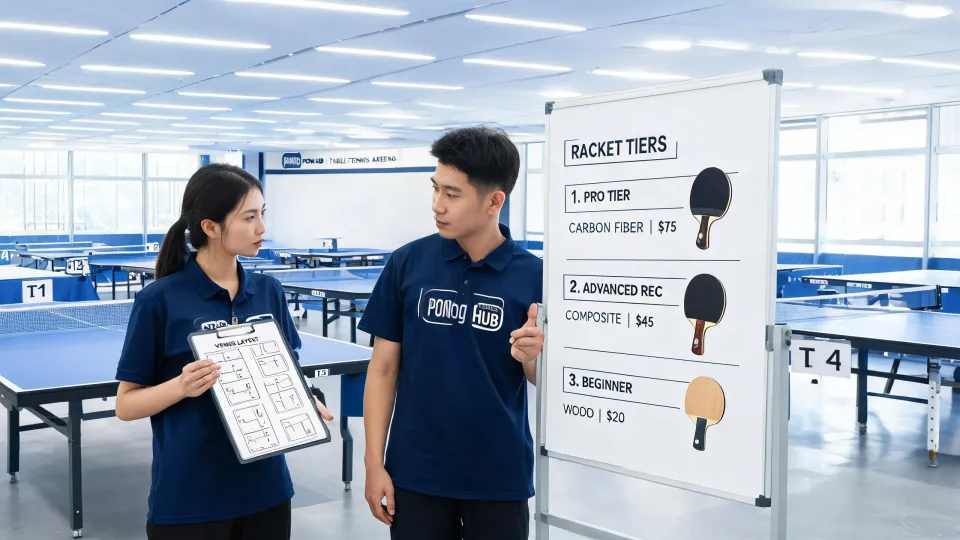
Pro tip for store owners: Pair the paddle with a table recommendation. When you sell a STIGA Advantage table (a solid mid-range model), suggest the Evolution 50 as the natural match. It’s a $20 add-on that increases basket value and reduces returns.
Scenario C: Competitive Clubs and Schools—Specs Are Non-Negotiable
If you’re buying for a training academy, a high school team, or a tournament venue, generic advice doesn’t cut it. You need equipment that meets ITTF standards and holds up to daily high-intensity play.
People think expensive vendors deliver better quality. Actually, vendors who consistently hit spec tolerances can charge more. The causation runs the other way. In 2023, we received a batch of 1,200 STIGA Pro 35 tables for a tournament sponsor order. The spec called for 25mm MDF with ±0.5mm thickness tolerance. The supplier sent 24mm boards claiming it was “within industry standard.” Normal tolerance for budget tables might be ±1mm, but for competition use, that’s a fail. We rejected the entire shipment—850 tables were already in transit. That delay cost the client $22,000 in rescheduled court bookings.
For competitive settings, stick with the STIGA Performance or Master series. These come with 22-25mm tops, consistent bounce ratings, and clamp-based net systems. If you’re buying paddles, look at the Evolution 90 or STIGA Pro Carbon—blades that offer genuine feedback for advanced strokes. Don’t bother with the combo sets that throw in a free case; the case quality is usually an afterthought.
Another blind spot: Most clubs focus on the table surface and ignore the net tensioning mechanism. A net that sags mid-game ruins the experience at any level. STIGA’s Quick-Release net systems (found on the Performance series) hold tension consistently—I tested a batch on a 10-game session with zero re-tightening. That’s a small but real edge.
How to Decide Which Scenario You’re In
Here’s a quick 3-question check. Answer honestly:
- How many games per week will this equipment handle?
— Under 20? You’re likely in Scenario B.
— 20 to 50? Scenario A.
— 50+? Scenario C. - Who’s the end user?
— Strangers renting time → Scenario A.
— Individual buyers browsing a store → Scenario B.
— Trained players or coaches → Scenario C. - What’s your tolerance for failure?
— Low (a broken table means lost revenue) → Scenario A or C.
— Moderate (returns are annoying but manageable) → Scenario B.
The vendor who says “this model isn’t right for your traffic level—here’s a better fit” earns my trust for everything else. That’s the kind of conversation you should be having.
“The best part of getting our STIGA vendor catalog standardized by use case: no more 2am worry sessions about whether a customer’s table will arrive on time and actually match what they ordered.”
Bottom line: there’s no universal “best STIGA table” or “best ping pong paddle.” There’s only the one that fits your business model. Focus on durability for public spaces, perceived value for retail, and spec consistency for competitive use. Everything else is marketing noise.