-
Who Is This Checklist For?
-
Step 1: Decouple the 'Prime' Product from the 'Loss Leader' Accessories
-
Step 2: Is the 'Premium' Justified by Your Use Case? (The Pro Carbon Racket Test)
-
Step 3: Calculate the 'Bump' and 'Storage' Costs
-
Step 4: The 'Competing Game' Factor (Snooker vs. Pool vs. Table Tennis)
-
Step 5: The Warranty & Return Investigation
-
Final Note: The Biggest Mistake
Who Is This Checklist For?
If you're the person signing off on orders for a sports facility, a school district, or a retail chain, this is for you. You're likely juggling requests for 'the best' paddles and 'the most durable' tables, but you know that 'best' usually comes with a hidden price tag. This checklist is for the moment when you're comparing quotes for a STIGA Talon table tennis racket bulk order or reviewing feedback on STIGA Onyx table tennis table reviews.
I've been in your shoes. For the past 6 years, I've managed a $180,000 annual budget for recreational equipment. This checklist is built from the mistakes I made and the system I built to stop making them. It's 5 steps. Do them in order, and you'll avoid the traps that inflate your total cost.
Step 1: Decouple the 'Prime' Product from the 'Loss Leader' Accessories
This is the one most people miss. They see a price on a STIGA Onyx indoor table tennis table and think, "Great, that's the cost." It's not. The cost is the table, plus the paddles, plus the balls, plus the net replacement, plus the floor mats. Vendors know this. They'll give you a great price on the headline item (the table) to make the total quote look good, then mark up the accessories you absolutely need.
The first time I audited our 2023 spending, I found we'd spent 22% more on replacement nets and balls than we had on the tables themselves. We were buying high-end tables but cheaping out on the consumables. That's a budget imbalance.
So for Step 1, get a quote that includes the full ecosystem. For the STIGA Talon racket, you need to know the price of the blade and the rubbers separately if you're building them. Or, if you're buying pre-assembled, confirm the quality of the included rubber. A cheap rubber on a good blade is a waste of the blade's potential. I'd argue the total cost of ownership for a table tennis setup includes the first year of balls and a quality net. Get that bundled price.
Checklist for Step 1:
- [ ] Get a line-item quote for the main product AND all mandatory accessories.
- [ ] Ask about 'complete setup' pricing (table, net, 2 paddles, 6 balls).
- [ ] Compare the accessory markup against retail prices from a third party.
Step 2: Is the 'Premium' Justified by Your Use Case? (The Pro Carbon Racket Test)
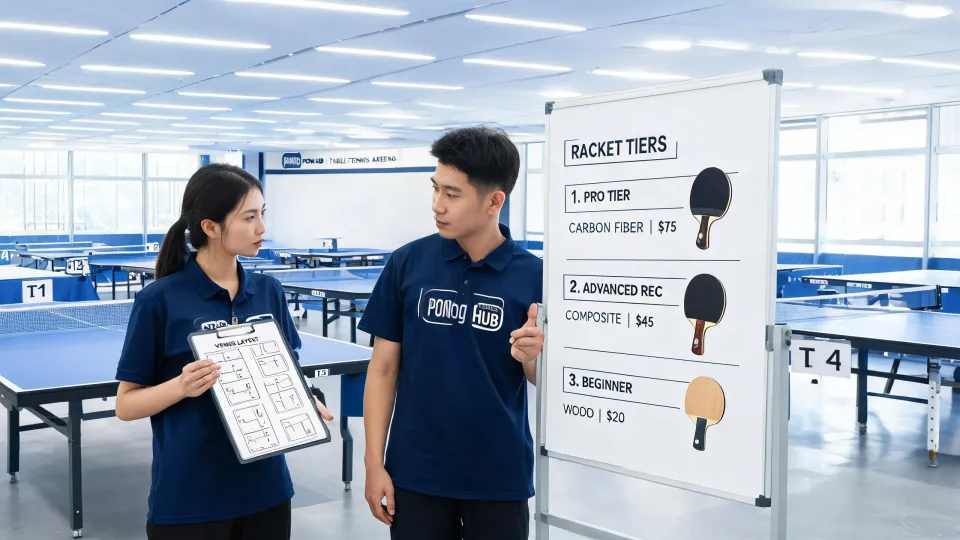
Here's where the STIGA Pro Carbon racket comes in. It's a fantastic piece of equipment. But is it the right choice for your customers or users? If you're stocking a hotel rec room, the Pro Carbon is overkill. The tourist playing once a month won't notice the difference in carbon fiber layup. They'll just lose the ball more. For a serious club? Absolutely.
This is where the efficiency is competitiveness mindset kicks in. Matching the product tier to the user segment isn't being cheap—it's being efficient. It saves you from buying $80 rackets when a $25 paddle would work, and it saves you from losing serious players because you didn't offer a pro-level option.
I once bought a batch of high-end blades for a 'premium' offer we were testing. They sat on the shelf for 6 months. The 'cheap' option in that case was actually the waste of capital tied up in inventory. We switched to a just-in-time ordering model for pro gear, and it cut our inventory carry cost by 15%.
So, before you order 50 STIGA Pro Carbon rackets, ask who is swinging them. If the answer is 'mostly casual players,' step down to a model like the STIGA Talon which is a great intermediate option. It's a better use of your budget.
Checklist for Step 2:
- [ ] Define the primary user skill level (Beginner / Intermediate / Pro).
- [ ] Match the product tier to the highest volume user segment, not the loudest request.
- [ ] Consider a 2-tier purchasing strategy (e.g., 80% intermediate gear, 20% pro gear).
Step 3: Calculate the 'Bump' and 'Storage' Costs
This sounds obvious, but tables are big and heavy. I didn't fully understand the value of a detailed shipping specification until I had to pay a $400 'lift gate' fee because our loading dock was booked, and the delivery truck didn't have a lift gate. That was a $3,000 order, and the $400 fee was 13% of the total. It came from a vendor who had quoted me a 'free shipping' price but didn't specify delivery method.
Check the dimensions of a STIGA Onyx table tennis table. It's a standard foldable, but it's bulky. Can you store it? What's the cost of the floor space? I built a simple calculation: Square footage of storage area × annual cost per square foot. A table takes up about 25 sq ft. In my facility, that's $18/month in 'rent' for the table. Over 3 years, that's $648 in storage cost—almost as much as the table itself! That doesn't mean you don't buy it; it means you plan for it.
Also, consider the 'bump' cost. Tables that aren't on rollers get bumped, scratched, and dented. The replacement cost for a damaged playing surface is higher than the initial purchase. I've seen a $15 investment in a floor mat prevent a $150 scratch repair. That's a good return.
Checklist for Step 3:
- [ ] Verify delivery method (curbside vs. lift gate vs. inside delivery).
- [ ] Calculate the annual storage cost for the product. (Sq Ft × Cost/Sq Ft).
- [ ] Budget for protective gear (mats, covers) as a line item, not a 'nice to have.'
Step 4: The 'Competing Game' Factor (Snooker vs. Pool vs. Table Tennis)
You're not just buying a table tennis table. You're buying indoor recreation. I had to learn this the hard way. We once replaced two pool tables with five table tennis tables because the feedback was that ping pong was 'more active'. What we didn't account for was the different demographic. Our pool league players stopped coming. They didn't want to play ping pong. We lost regulars.
When you see a query like snooker table vs pool table, what you're really seeing is a customer trying to figure out which game gives them the best 'entertainment per square foot'. A 9-foot snooker table takes up about 72 sq ft. A 9-foot pool table takes about 64 sq ft. A standard table tennis table takes about 20 sq ft. But the playability is different. Table tennis is fast and active. Snooker is slow and strategic. Pool is social.
From a procurement standpoint, you need to decide: are you buying for high turnover (fast play, like table tennis) or for stationary groups (social play, like pool)? The answer dictates your equipment budget and your space layout. Don't think a treadmill foldable or a gloomhaven board game is a direct replacement. The activity is different. The table tennis table can be folded away, which is a massive storage efficiency win compared to a permanent pool table. That's a concrete cost advantage.
Checklist for Step 4:
- [ ] List the competitor activities in the space (Pool, Foosball, Arcade).
- [ ] Determine the player profile for each activity.
- [ ] Calculate the 'revenue per square foot' or 'usage per square foot' for each game.
- [ ] Prioritize games with foldable/portable options for flexible space use.
Step 5: The Warranty & Return Investigation
This is my final step, and it's a big one. I was once sold on a 'lifetime warranty' for a set of tables. Turns out, 'lifetime' was the life of the product, defined as 5 years. And the warranty only covered manufacturer defects, not normal wear and tear. Guess what? A net breaking is normal wear and tear. A leg bending from a light bump? 'User damage,' they said.
For STIGA, the brand is well-established, so warranty terms are generally clear. But you still need to check two things:
- Replacement parts availability: How much is a replacement net or a set of legs for a STIGA Onyx table tennis table? If a part breaks, is it cheaper to just buy a new table? I've compared costs for a $45 replacement net for a competitor's table vs. a $25 generic net that fits 80% of tables. Sometimes, the generic part is the better business decision. According to general USPS Business Mail 101 standards, even packaging dimensions matter for shipping replacements.
- The return process: What happens if a table arrives damaged? Do you have to pay return shipping on a 250-lb box? The cost of a returned item can be 30-40% of its value. I've instituted a policy to take a photo of the delivery before the truck leaves. It's saved us $4,200 in disputed damage claims over 2 years.
Make sure you have a clear, documented process for this before you order. Don't trust a verbal promise.
Checklist for Step 5:
- [ ] Read the full warranty document (not just the summary).
- [ ] Document the process for reporting shipping damage (photos, timeline).
- [ ] Source prices for the 3 most likely replacement parts (net, rubber, leg).
Final Note: The Biggest Mistake
The biggest mistake I still see—and I've made it myself—is thinking this is a one-time purchase. It's not. It's a recurring budget item. You'll buy nets again. You'll buy balls again. You'll buy new blades in 2 years. Treat the first order as the beginning of a 3-year relationship with the vendor, not a one-off transaction.
If you follow this checklist for your next order of table tennis equipment—whether it's a single STIGA Talon or a fleet of STIGA Onyx tables—you'll have a clear cost picture. And isn't that the entire point of procurement? To know exactly what you're paying for, before you pay for it.